


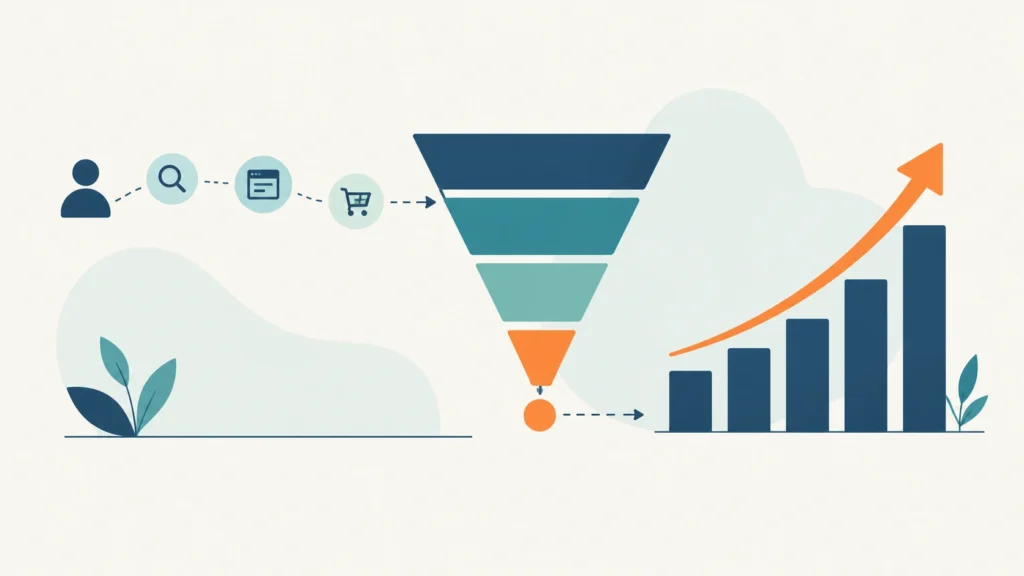
Business Growth Marketing, Explained Simply
Business growth marketing means treating your marketing like a system, not a series of one-off campaigns. Every stage of the customer journey gets attention: how people find you, what happens right after they show interest, whether they stick around, and whether they tell someone else about you.
Most businesses I come across are doing marketing. Just not growth marketing. There’s a real difference, and it usually comes down to one thing.
They’re running ads or posting content and hoping something sticks. No testing. No clear picture of where people actually drop off. That’s not a growth system. That’s marketing on autopilot.
Full-Funnel Approach vs. Traditional Marketing
Traditional marketing usually stops at getting attention. Get the click, get the sale, and move to the next campaign.
Growth marketing looks at what happens after that click too. It tracks a person from the first time they hear about your business all the way through to whether they come back and whether they refer someone else.
Here’s why that matters. A business can spend a fortune getting new visitors and still struggle to grow if those visitors never come back. I’ve seen this play out more than once. Traffic goes up. Revenue barely moves. And the reason is almost never the ad. It’s what happens after someone lands on the page.
Traditional marketing asks, “How do I get more people to notice me?”
Growth marketing asks, “What happens to the people who already noticed me, and where are they falling out of the process?”
That second question is the one most businesses skip.
Why Data-Driven Decisions Beat Guesswork
The short answer is that guessing wastes money, and data tells you exactly where to stop wasting it.
I check the numbers before I trust my gut on anything. Not because instinct doesn’t matter. It does. But instinct without data usually points you toward what feels right instead of what’s actually working.
A landing page might look great. Clean design, strong copy, everything you’d expect. And it still converts at half the rate of an uglier page down the funnel that nobody thought twice about.
You only catch that by looking at the actual numbers. Bounce rate, drop-off points, and where people hesitate before buying. These aren’t abstract metrics sitting in a dashboard somewhere. They’re a map of exactly where your business growth marketing effort is leaking money.
Data doesn’t replace judgment either. It just gives judgment something real to work with.
Rapid Experimentation Over One-Time Campaigns
A single campaign tells you almost nothing on its own. It tells you what happened once, under one set of conditions, with one audience mood on one particular day.
Growth marketing runs small, fast tests instead. Two versions of a headline. Two different offers. A shorter checkout process against the original one. Small changes, tested quickly, then scaled once something clearly works.
This is the part most guides gloss over. Testing isn’t glamorous. It’s slow and sometimes boring, and results aren’t always dramatic. But it’s the difference between marketing that improves over time and marketing that just repeats the same mistakes with a new coat of paint.
I’d rather run five small tests in a month than launch one big campaign and hope. The small tests fail cheaply. The big campaign, if it’s wrong, fails expensively.
That’s really the whole philosophy behind business growth marketing in one sentence: fail small, learn fast, and scale what actually works.
Business Growth Marketing vs Digital Marketing vs Performance Marketing
People use these three terms like they’re interchangeable. They’re not, and mixing them up is usually why a business ends up hiring the wrong kind of help.
Digital marketing is the broadest of the three. It’s basically every channel you use online: websites, social media, email, ads, and search. Performance marketing is narrower. It’s the paid side of that—ads you run specifically to get a measurable action, a click, a signup, or a sale. Growth marketing sits above both of them. It’s not a channel. It’s an approach that pulls from digital and performance marketing, along with product, retention, and referral work, all pointed at one goal.
So when someone asks me whether they need growth marketing or digital marketing, that’s actually the wrong question. It’s like asking whether you need a toolbox or a hammer.
Where the Three Overlap
All three use the same channels. Ads, email, content, social, and search. That’s exactly why the confusion happens in the first place.
A performance marketer and a growth marketer might both be running Facebook ads this week. Same platform, same budget, same audience even. From the outside it looks identical.
The overlap goes deeper than channels too. All three care about tracking results. Nobody serious in any of these three fields is just throwing money at ads and hoping.
Here’s where it gets confusing for most business owners. A digital marketing agency might mention “growth” in their pitch deck. A performance marketing freelancer might talk about a “full funnel” strategy. The language gets borrowed constantly, and that’s exactly why so many people end up hiring the wrong kind of help for the wrong kind of problem.
Where They’re Actually Different
The real difference comes down to scope and what happens after the click.
Digital marketing is about presence and visibility across channels. It answers the question, “How do I show up where my customers are?” That’s the entire job. Get the brand seen, get the message out.
Performance marketing is about a single measurable action, usually paid. Someone clicks, someone converts, and the campaign’s job is done. It lives and dies by cost per acquisition and return on ad spend. Nothing wrong with that. It’s just narrow by design.
Growth marketing is the one that keeps going after the sale happens. It’s asking what occurs after someone buys. Do they come back? Do they tell a friend? Does their lifetime value justify what it cost to get them in the first place?
I’ve worked with businesses that had strong performance marketing numbers on paper. Low cost per click, decent conversion rate. And they were still struggling to grow. Why? Because nobody was looking at what happened after the sale. Customers bought once and disappeared.
That’s the part performance marketing was never built to catch. And it’s the exact gap business growth marketing exists to close.
So the real question isn’t which one you need. It’s whether you need visibility, a specific conversion, or a system that keeps working after the first sale. Most growing businesses eventually need all three working together, just not run the same way or measured against the same numbers.
My Growth Marketing Strategy Framework
My growth marketing strategy runs on five stages, based on what’s commonly known as the AARRR framework, and they’re not equally important for every business. That’s the part most frameworks get wrong. They present all five like they deserve the same attention, when really, most businesses have one stage bleeding money while the other four look fine.
The order matters too. You can’t fix retention if activation is broken. You can’t chase referrals from customers who never stuck around long enough to like the product.
Here’s how I actually work through it.
Acquisition — Getting the Right Attention
Acquisition means getting the right people to notice you, not just more people.
This distinction sounds small. It isn’t. I’ve watched businesses double their traffic and see almost no change in revenue. More visitors, same sales. Because the extra traffic was never the right audience to begin with.
Cheap traffic that doesn’t convert isn’t a win. It’s a distraction dressed up as progress.
Before spending on acquisition, I look at who’s already converting. Not who’s visiting. Who’s actually buying? That tells you more about where to find similar people than any targeting option in an ad platform ever will.
And this is exactly where things go wrong for a lot of businesses. They chase volume first and figure out targeting later. Backwards. Should be the other way around.
Activation — First Impressions That Convert
Activation is what happens in the first few minutes after someone shows interest, and it’s usually where the most damage gets done without anyone noticing.
A visitor lands on your site. Signs up. Fills out a form. What happens right after that moment decides whether they stick around or quietly leave and never come back.
Confusing next steps. A slow follow-up email. A checkout process with too many fields. Small friction points, individually forgettable, but stacked together they quietly bleed conversions.
I check this stage first with almost every business I work with, because it’s the cheapest fix with the fastest payoff. Fixing acquisition takes weeks. Fixing a confusing signup flow can take an afternoon.
The fix is usually simple, or at least simpler than most people expect when they first run into the problem.
Retention—Keeping Customers Engaged
Retention is whether a customer comes back, and it’s the stage most businesses ignore until growth stalls out completely.
New customer acquisition costs more than keeping an existing one. That’s not new information. Most business owners already know it. Knowing it and actually building a strategy around it are two very different things.
Retention isn’t complicated most of the time. It’s follow-up emails that actually add value instead of just pushing another sale. It’s checking in before a subscription renews instead of after someone’s already cancelled. It’s noticing when usage drops off and reaching out before the customer disappears for good.
Not glamorous work. But it’s usually the highest-leverage part of the entire funnel, and almost nobody wants to do it because it doesn’t feel as exciting as launching a new campaign.
Referral — Turning Customers Into Advocates
Referral means your existing customers bring you new ones, and it only works once retention is already solid.
You can’t build a referral engine on customers who aren’t sticking around. That’s the order problem again. Fix retention first, or the referral effort has nothing to build on.
The businesses that do this well make it easy and make it worth doing. A simple ask at the right moment. A small incentive, if it fits. Removing every excuse someone might have not to bother recommending you.
Word of mouth is still one of the most trusted forms of marketing there is. People believe a friend’s recommendation over an ad. Every time. The catch is that referral can’t be forced. It has to be earned first, through the product or service actually being worth talking about.
Revenue—Maximizing Long-Term Value
Revenue in this framework isn’t just the number on an invoice. It’s the full value a customer brings over the entire relationship, not just the first purchase.
This is where all four earlier stages show up on a spreadsheet. Good acquisition brought the right people in. Good activation got them started. Good retention kept them around. A good referral brought their friends too. Revenue is the result, not a separate lever you pull on its own.
Businesses chasing quick revenue tend to focus on the first sale and stop there. Businesses building real growth marketing strategy focus on lifetime value instead of upsells, repeat purchases, longer subscriptions, and referrals that compound over time.
That shift in focus, from one sale to a relationship, is really what separates growth marketing from a marketing campaign that just happens to work once.
Ready to Fix What’s Actually Broken?.
One funnel. One clear plan. No guesswork. [Start With a Strategy Call →]
Growth Marketing Examples Worth Learning From
Most growth marketing examples people bring up are the same three or four companies. Big names, huge budgets, product-led growth machines. Useful to know about, but not exactly relatable if you’re running a service business or a small online shop trying to figure out what to do this month.
Real growth marketing examples don’t need a massive budget or a viral moment. They need someone actually paying attention to where the funnel leaks and fixing it, one stage at a time.
Let me break down both kinds. The relatable ones and the famous ones. Because they teach different lessons.
Small and Mid-Sized Business Applications
For a smaller business, growth marketing usually looks unglamorous. No big product launch. No press coverage. Just small, consistent fixes.
A local service business, for example, might notice most leads come through a contact form, but almost nobody actually books a call after filling it out. That’s an activation problem, not an acquisition one. The fix isn’t more ads. It’s a faster follow-up, maybe a booking link instead of a form, something that removes friction right at the point people are ready to act.
An online store might see plenty of traffic but a high cart abandonment rate. Growth marketing here means testing checkout flow, not throwing more money at ads to compensate for a leak nobody’s plugged.
I’ve seen businesses fix a five-minute delay in their email follow-up sequence and watch their conversion numbers shift meaningfully. Not because the product changed. Because the timing did.
These aren’t dramatic stories. They’re small operational fixes, tested and applied consistently. That’s most of what business growth marketing actually looks like day to day, and it’s honestly the part nobody puts in a case study because it doesn’t sound exciting enough to write about.
Recognized Brand Case Studies
The well-known examples earn their reputation because they show the framework at a scale most businesses will never touch, but the underlying logic still holds.
Dropbox is the one everyone mentions, and for good reason. Instead of spending heavily on ads, they built a referral system that gave both the person referring and the person joining extra storage space. That single mechanic turned existing users into an acquisition channel, which is really a referral strategy solving an acquisition problem.
Airbnb took a different route early on. Rather than only running ads, the company tapped into an existing platform where people were already looking for accommodation, Craigslist, and met potential customers where they already were instead of trying to pull them somewhere new.
HubSpot built a free tool, a website grader, that gave people something useful before ever asking for a sale. That’s activation and acquisition working together. Get someone real value first, earn the trust, then make the offer.
None of these worked because the company had a bigger budget than everyone else. They worked because someone identified exactly where the funnel was weak and built a specific mechanic to fix that one weak point.
Lessons That Apply Beyond the Big Names
The lesson isn’t “build a referral program” or “make a free tool.” That’s the surface-level takeaway, and it misses the actual point.
The real lesson is that each of these companies looked honestly at one weak stage in their funnel and built something specific to fix it. Dropbox didn’t guess that referrals would work. They tested it against other acquisition methods first. Airbnb didn’t randomly pick Craigslist. They went to where their exact audience already was.
That’s the part worth copying. Not the tactic itself, the process behind choosing it.
For a smaller business, that means actually looking at your own numbers before copying someone else’s growth marketing examples. What is Dropbox’s referral program solving that your funnel doesn’t even have as a problem? Maybe your issue isn’t referrals at all. Maybe it’s activation, and you’re borrowing a solution for the wrong stage entirely.
Every growth marketing example worth learning from starts the same way. Find the specific leak. Build something specific for it. Test whether it actually closes the gap.
Not: pick a famous tactic and hope it transfers.
Growth Marketing Metrics I Track
Growth marketing metrics only matter if they change what you do next. That’s the filter I run every number through before I even look at it twice.
Most businesses track too many numbers and act on almost none of them. Dashboards full of charts, and nobody can say what actually needs to happen this week because of them.
I don’t track everything. I track what tells me exactly where the funnel is leaking, and I ignore the rest until it becomes relevant.
Early-Stage Priorities — Activation & Retention
Early on, activation and retention tell you more than any other numbers you could look at.
Activation rate is simple. It’s the percentage of people who take that first meaningful action after showing interest. Signing up isn’t activation. Actually using the thing, booking the call, and completing the first purchase—that’s activation. A lot of businesses celebrate signups and never check whether those signups turn into anything real.
Retention is the second one I check immediately after. What percentage of customers are still around after thirty days? Sixty? Ninety?
Here’s why these two come first. If activation is broken, nothing downstream matters yet. You can’t fix a referral problem when people never get far enough to want to refer anyone. And if retention is bad, you’re just refilling a leaking bucket, spending on acquisition to replace customers who were never going to stay regardless of how good your ads were.
I’ve seen businesses obsess over traffic numbers while their retention sat quietly at a rate that made growth almost impossible. Fix retention first. Everything else gets easier after that.
Mid-Stage Priorities — Referral & Customer Lifetime Value
Once retention holds steady, referral rate and customer lifetime value become the numbers worth watching closely.
Referral rate tells you what percentage of customers are bringing in new customers; whether through a formal program or just word of mouth, you can trace back to them. Low doesn’t necessarily mean bad. It just means there’s no mechanism in place yet to encourage or track it, and that’s worth fixing once the fundamentals are solid.
Customer lifetime value is the one that changes how you think about acquisition spend entirely. A customer worth five hundred dollars over their relationship with you changes what you’re willing to pay to acquire them, compared to a customer worth fifty.
This is where a lot of the earlier guesswork gets replaced with real numbers. Once you know lifetime value, acquisition cost stops being a number you’re nervous about and starts being a number you can actually justify, or one you know needs to come down.
Long-Term Priorities — Revenue & ROI
Revenue and return on investment tie everything back to whether the whole system is actually worth running.
Revenue by itself doesn’t tell the full story, though. Revenue that costs more to generate than it brings in isn’t growth. It’s just movement that looks like growth on a surface-level report.
ROI is the number that keeps everyone honest. For every dollar spent across the funnel, acquisition, retention efforts, and referral incentives, what’s actually coming back? This is the number that separates growth marketing that’s working from growth marketing that just feels busy.
I check this one last, not because it matters least, but because it only means something once the earlier stages are already healthy. A high ROI built on top of broken activation or weak retention won’t hold up. It’s borrowed performance, and it usually shows up as a problem later once the early wins wear off.
Tools I Use to Track Growth Marketing Data
The tools matter less than most people think. The habit of actually checking the data regularly matters more.
For traffic and behavior, an analytics platform that shows where people drop off in the funnel is non-negotiable. Not just how many visitors, but where they lose interest and leave.
For anything involving repeat customers, a CRM that tracks purchase history and engagement over time earns its place quickly. Without it, retention and lifetime value stay guesses instead of numbers you can actually act on.
Heatmap and session recording tools help with the activation stage specifically. Watching where someone hesitates on a page tells you things a spreadsheet full of numbers never will.
None of these tools do the work for you, though. They just show you where to look. The actual growth marketing decision still comes down to someone reading the data honestly and being willing to act on what it says, even when it points to something you didn’t expect to find.
Business Growth Marketing Services I Offer
I don’t offer a long list of generic services. I offer four, and each one solves a specific problem in the funnel, not a vague “we do marketing” package.
Here’s what that actually looks like.
Growth Strategy & Funnel Audits
Before I touch a single channel, I look at where the funnel is actually breaking. Not where you think it’s breaking. Where the numbers say it is.
A funnel audit means walking through every stage a customer goes through: acquisition, activation, retention, referral, revenue, and finding the one or two spots doing the most damage. Most businesses assume they have an acquisition problem when the real issue is sitting further downstream.
This is usually where I start with anyone I work with. Fixing the wrong stage first wastes time and money. Finding the actual leak first means everything after that gets easier.
SEO & Organic Growth
Paid traffic disappears the moment you stop paying for it. Organic traffic keeps working long after the work is done.
SEO inside a growth marketing strategy isn’t just about ranking for keywords. It’s about building content and pages that match what someone’s actually looking for at each stage: informational content for people still researching, service pages for people ready to act.
I treat SEO as a long-term acquisition channel, not a one-time project. Rankings shift, search behavior shifts, and a page that worked a year ago needs revisiting, not abandoning.
Conversion Rate Optimization
Traffic without conversion is just a number that looks good in a report and does nothing for revenue.
CRO means testing the actual moments where people hesitate or drop off. A confusing checkout step. A call to action that’s buried instead of obvious. A page that loads slow enough that people leave before they even see the offer.
I test these changes instead of guessing at them. Small adjustments, measured against real behavior, not opinions about what should work.
Retention & Lifecycle Marketing
Getting someone to buy once is the easy part. Getting them to stay is where most of the actual growth marketing work happens.
Lifecycle marketing means building the follow-up systems that keep customers engaged after the first sale, email sequences that add value instead of just pushing another offer, check-ins before a subscription lapses instead of after, and win-back campaigns for customers who’ve gone quiet.
This is the piece most businesses skip because it’s less exciting than launching a new campaign. It’s also usually the highest-leverage fix available, because keeping an existing customer costs far less than acquiring a new one.
Digital Marketing’s Role in Business Growth
Digital marketing isn’t the whole growth strategy. It’s the delivery system for it.
Every stage of the funnel I’ve talked about so far—acquisition, activation, and retention—needs a channel to actually reach people. That’s what digital marketing provides. Without it, growth marketing is just a plan with nowhere to go.
The mistake I see most often is businesses treating digital marketing and growth marketing as the same thing. They’re not. Digital marketing gets you the channels. Growth marketing tells you which channels matter right now and what to do once someone’s actually there.
SEO as a Long-Term Growth Channel
SEO is slow at the start and cheap for years after that. That trade-off is exactly why I treat it as a foundation, not an experiment.
A paid campaign stops the moment the budget runs out. A page that ranks well keeps bringing in visitors months, sometimes years, after it was published. That difference alone changes how I plan a growth marketing strategy around it.
The catch is that SEO doesn’t respond well to shortcuts. Thin content, keyword stuffing, and pages built for search engines instead of people—all of it eventually gets filtered out. What actually works is content built around real search intent, answering the exact question someone typed in, not circling around it.
I’ve seen businesses ignore SEO for a year, chasing faster wins through ads instead, and then wonder why their acquisition cost never came down. Paid traffic can validate an offer fast. It rarely makes a business cheaper to run over time. Organic traffic does.
Content Marketing for Organic Growth
Content is what actually earns the ranking SEO depends on. Without it, there’s nothing for search engines or people to find.
Good content marketing isn’t about publishing constantly. It’s about publishing the right thing at the right stage. Someone researching a problem needs a different page than someone ready to buy. Mixing those up is why a lot of content gets traffic and still doesn’t convert.
I map content to where someone actually sits in the funnel. Early-stage content builds trust and answers questions honestly, without pushing a sale too soon. Later-stage content, service pages, comparisons, and case-based explanations are where the actual conversion work happens.
This is the part that takes patience. A single blog post rarely moves the needle. A body of content, built consistently around real questions people are asking, compounds in a way that one-off campaigns never do.
Paid Channels for Faster Validation
Paid channels exist for one thing mainly: speed. They tell you fast whether an offer or message actually works, without waiting months for organic results to show up.
I use paid ads early in a growth marketing strategy specifically to test, not to scale blindly. A small budget across two or three ad variations tells you which message resonates before committing real money to it. That data then feeds back into everything else: the content, the landing pages, and even the SEO targeting.
Where this goes wrong is when businesses treat paid channels as the permanent growth engine instead of the testing ground they’re better suited for. Ad costs climb. Margins get thinner. And the business ends up dependent on a channel that gets more expensive every year it relies on it.
Paid and organic aren’t competing against each other in a growth marketing strategy. Paid tells you what works fast. Organic makes what works sustainably.
Marketing Ideas for Business Growth That Actually Work
Most marketing ideas for business growth aren’t actually ideas. They’re recycled tips lists, post more on social media, start an email newsletter, and run some ads. None of that is wrong exactly. It’s just not specific enough to act on.
The ideas that actually move the needle depend entirely on where your business is right now. What works for a business with no traction yet looks almost nothing like what works for one that already has customers and just needs to grow faster.
That distinction matters more than the tactic itself.
Low-Budget Tactics for Early-Stage Businesses
Early on, the goal isn’t scale. It’s proof that something works before spending real money to amplify it.
Answering questions your exact customer is already asking, on forums, in comments, and in your own content costs nothing but time and builds trust faster than an ad ever will. People trust a real answer over a sales pitch, especially when they didn’t ask for the pitch.
Partnering with a business that shares your audience but isn’t a competitor works better than most people expect. A cross-promotion, a shared offer, or even just a mention to each other’s list costs almost nothing and puts you in front of people who already trust the person introducing you.
Following up personally with early customers, not an automated email, an actual message, tells you exactly what’s working and what isn’t. I’ve seen businesses skip this step entirely and then wonder why their messaging doesn’t land. The answer was sitting in five conversations they never had.
Reviews and testimonials from those first customers matter more early on than almost any paid tactic. Social proof is cheap to gather at this stage and gets more expensive to fake later, which is exactly why gathering it honestly now pays off.
None of this requires a budget. It requires attention, and most early-stage businesses are too busy chasing acquisition to give it any.
Scaling Tactics Once You Have Traction
Once something’s proven to work, the question changes. It’s no longer “does this work.” It’s “how much can this handle before it breaks?”
Doubling down on the channel that’s already converting beats, spreading thin across five new ones you haven’t tested. I see businesses with one channel quietly working well get distracted chasing the next platform instead of squeezing more out of what’s already proven.
Retargeting the people who showed interest but didn’t convert the first time is one of the highest-return moves available once you have enough traffic to retarget meaningfully. They already know you. The friction is lower the second time around.
Building a referral mechanism becomes worth the effort once retention is solid, not before. Asking happy customers for referrals when the product or service already delivers is a very different conversation than asking customers who are lukewarm at best.
Repurposing what’s already working, turning a high-performing piece of content into a different format, and testing the same offer in a new channel extend the life of something proven instead of starting from zero every time.
Scaling isn’t about doing more things. It’s about doing the few things that are already working, with more consistency and less hesitation than before.
Once something’s proven to work, the question changes. It’s no longer “does this work.” It’s “how much can this handle before it breaks.” That’s really where scaling tactics come in, and it’s a different conversation than the one you were having when you were just trying to prove the idea worked.
Signs Your Business Needs a Growth Marketing Consultant
Not every business needs a growth marketing consultant. Some do fine handling it themselves, at least for a while. The honest answer depends on time, skill, and how much guessing you’re willing to pay for.
I get asked this a lot, usually by someone who’s already spent months trying things without a clear system behind any of it. By the time that question comes up, the answer is usually already obvious. They just haven’t said it out loud yet.
Not every business needs a growth marketing consultant. Some do fine handling it themselves, at least for a while. The honest answer depends on time, skill, and how much guessing you’re willing to pay for.
When to Handle Growth Marketing In-House
If you have the time to actually test things and the patience to read the data honestly, in-house works fine.
A small business with one or two channels, a founder willing to check analytics weekly, and enough runway to let tests play out doesn’t need outside help yet. The fundamentals I’ve covered here—tracking activation, fixing retention before chasing referrals, and testing instead of guessing—are not secret knowledge. They just take consistent attention.
The businesses that do this well tend to have one person genuinely owning the numbers. Not checking them occasionally. Actually living in them, noticing when something shifts, and asking why before assuming it’s random.
Where this breaks down is time, not intelligence. Most founders already have a business to run. Marketing becomes the thing that gets attention on a good week and gets ignored the moment something urgent comes up. That inconsistency is usually what stalls growth, not a lack of knowledge about what to do.
When Outside Expertise Pays Off Faster
Outside help earns its cost when the guessing has already gone on too long or when nobody internally has the time to test things properly.
If you’ve tried several tactics and can’t say clearly what worked and why, that’s usually a sign the testing wasn’t structured to begin with. A growth marketing consultant brings a framework for that. Not magic. Just a system for isolating what’s actually driving results instead of changing five things at once and hoping.
Time is the other trigger. A business growing fast enough that nobody has bandwidth left to analyze the funnel properly is exactly the point where bringing in outside expertise stops being a nice-to-have and starts paying for itself. The cost of a consultant is usually smaller than the cost of continuing to guess at scale.
I’ll say this plainly. Hiring help doesn’t mean handing over control. It means having someone who’s seen the same funnel problems across different businesses spot the pattern faster than someone seeing it for the first time in their own numbers.
The businesses that get the most value from outside expertise are usually the ones who already have some traction. They’re not starting from zero. They just need someone to find the leak they can’t see because they’re too close to it.
My Process—Working Together
I don’t start any engagement with a generic package. I start by understanding exactly where a business stands, because the fix for one funnel almost never matches the fix for another.
Here’s how that actually plays out, step by step.
Discovery & Business Audit
Before I recommend anything, I ask questions most businesses haven’t been asked before. What’s your actual acquisition cost? Where do people drop off? What does a customer look like six months after they buy, not just on day one?
This stage is about looking at what’s really happening, not what you assume is happening. I go through the analytics, the funnel, the existing content and channels, and map out where the real leaks are sitting.
Most businesses expect this part to take a day. It usually takes longer, because doing it properly means checking the data instead of taking a guess based on a quick look.
Strategy & Roadmap
Once I know where the leaks are, I build a plan around fixing the highest-impact ones first. Not everything at once. The one or two things that will actually move the numbers.
The roadmap isn’t a generic template. It’s specific to what the audit found. If retention is the problem, the roadmap starts there, not with a new acquisition campaign that would just feed more people into a leaky funnel.
I explain the reasoning behind each priority too. Not just what we’re doing, but why that comes before something else on the list.
Execution & Monthly Delivery
This is where the plan actually gets built out. Testing, adjusting, and refining based on what the data shows each month rather than sticking rigidly to a plan that isn’t working.
I don’t treat the roadmap as fixed once it’s set. If a test underperforms, that tells me something real, and the next month’s priorities shift based on that. Growth marketing works because of that flexibility, not despite it.
Monthly delivery means there’s always something concrete moving forward. Not a strategy document sitting untouched. Actual changes, actual tests, actual progress you can see.
Still Guessing What’s Holding Your Growth Back?.
Let’s find the actual leak in your funnel — not another generic strategy. [Book a Growth Audit →].
Reporting & Direct Communication
I report on what actually matters, not a wall of vanity metrics that look good and mean nothing.
Every report ties back to the funnel stage we’re working on. If we’re focused on activation, the report shows activation numbers, what changed, and why. Not traffic charts that have nothing to do with the actual goal.
Communication stays direct because that’s what actually helps a business make decisions. No jargon dressed up to sound more complex than it is. Just what’s working, what isn’t, and what’s happening next.
Common Business Growth Marketing Challenges
Every business runs into the same handful of walls eventually. Budget, tracking, scaling. Not because they’re doing something wrong exactly, but because these three trip up almost everyone at some point.
Knowing what’s coming doesn’t make the problem disappear. It just means you’re not caught off guard when it shows up.
Limited Budget and Resources
Budget is the first constraint most businesses hit, and it shapes almost every decision after that.
A small budget means you can’t test five things at once. You test one, wait for a real answer, then move to the next. Slower than running everything in parallel, but it’s also the only honest option when there isn’t room to absorb a failed experiment that never gets analyzed properly.
I’ve seen businesses spread a small budget across too many channels at once, get inconclusive results everywhere, and walk away thinking none of it worked. The real problem wasn’t the channels. It was spreading too thin to ever get a clear answer from any of them.
The fix isn’t more money. It’s narrower focus. One channel, tested properly, tells you more than five channels tested halfway.
Inconsistent Tracking and Attribution
If you can’t say clearly where a customer came from, you’re not tracking growth marketing. You’re just watching numbers move without knowing why.
Attribution gets messy fast. Someone sees an ad, forgets about it, searches your business name a week later, and shows up as organic traffic in the reports. Multiply that across every channel and it’s easy to misread which efforts are actually working.
This is where a lot of businesses make the wrong call. They cut a channel that was quietly doing more work than the reports gave it credit for, because the tracking wasn’t set up to catch the full picture.
Fixing this doesn’t require anything complicated. It requires setting up tracking properly before you start spending, not trying to reconstruct it after six months of data that’s already unreliable.
Scaling Without Losing Quality
What works at a small scale doesn’t always hold up once you push more volume through it, and this is where a lot of growth marketing efforts quietly fall apart.
A personal follow-up email that converts well at ten customers a month becomes impossible to send personally at two hundred. The instinct is to automate it exactly as is. The mistake is assuming the automated version will perform the same way the personal one did.
Same with content. A blog that ranks well because it genuinely answers a specific question doesn’t scale by publishing ten similar posts a week. It scales by maintaining that same depth and specificity across more topics, which takes more time than most businesses budget for once they’re in growth mode.
The businesses that scale well are the ones that protect whatever made the original version work, even as they figure out how to do more of it. The ones that struggle are usually the ones that assumed more volume alone would keep producing the same results.
Frequently Asked Questions
Is growth marketing only for startups?
No. It’s associated with startups because they need to prove things work quickly, but the same funnel thinking applies to any business trying to grow more efficiently, established or not.
Is there a course or certification worth taking?
There are courses that teach the frameworks well, but growth marketing is learned mostly by testing on a real funnel and watching what the data actually says.
How long before growth marketing shows results?
Small activation or retention fixes can show movement within weeks. Bigger shifts, like SEO or lifetime value changes, usually take a few months to show clearly.
What’s the difference between growth marketing and growth hacking?
Growth hacking chases fast, often short-term wins with minimal resources. Growth marketing builds a sustainable system across the full funnel that keeps working long after the first win.
Do small businesses really need this?
Not always right away, but any business past the early stage benefits from knowing exactly where customers drop off instead of guessing. It just means doing the same thing more deliberately, not necessarily hiring help.
